Being and Being Well
Life can be thought of as a ceaseless attempt to be one’s version of “well”.
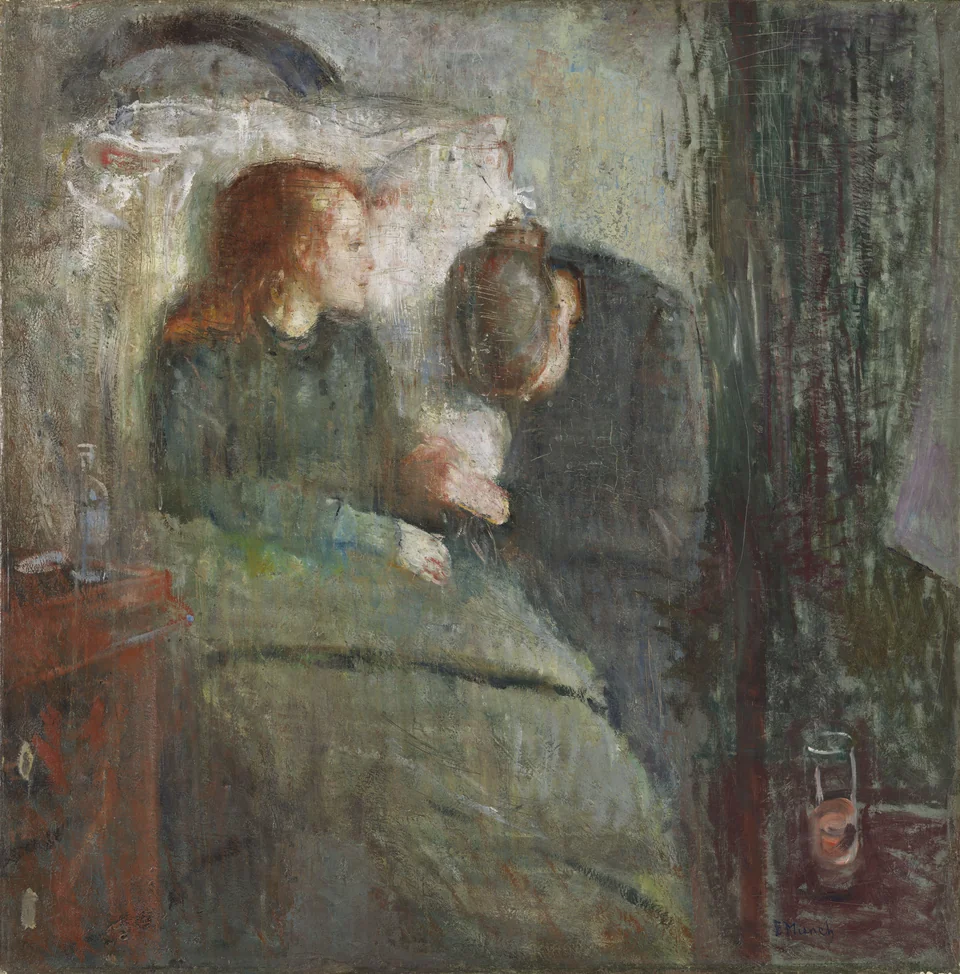
Getting better. Getting worse. Unchanged. All sickness nonetheless.
Life can be thought of as a ceaseless attempt to be one’s version of “well”.
You lie in bed and you have never been this close. A persistent cough, perhaps. You’re burning hot. Cold before, but this is certainly not better. You almost wish you were cold again but still remember how horrible that was. You feel weak, too weak for the body you find yourself in. You feel the tremendous weight of the air above you. Movement makes it all worse; movement brings all of it together. The pain. You’re confined to slight but excruciating jerks.
Better to be perfectly still. Maybe find a good position to rest in. Because you need the rest. Being… is a tiring thing. You need to rest. You imagine a permanent state of rest, the one interrupted every night by cold sweat drenching your burning body. At least this is a sign they would take seriously when you call for help. You hope… But deep inside you crave that feeling you barely felt at all. Between your eyes shutting and the moment of cold, painful sweat covering your burning, aching body, trapped under this heavy world of air. It was not a moment; you felt no time pass. You thought nothing. You decided nothing. You dreamed, but had you not, it would have meant nothing at all. That nothing. No time. Nothing. No place. Nothing. No reason. That, in your reality that no one could possibly understand, was everything.
Allow me to take you on the journey back.
Turn around.
On this road you’re on, look at the moments that have led to this perceived everything. If I take away the weight of the air that confines you, will that make it better? If I make the sweat stop, will the heat be bearable? One by one, if all that you feel, all the symptoms, go away… will that change your wants?
Biologically, as it has been taught to me, sickness seems to manifest as a communication of a state not desired. An underlying condition, be its origin genetic, acquired or seemingly spontaneous. This experienced state of discomfort shapes our healthcare systems’ attempts to describe and define “symptoms”. Our research observes how a process deviates from an established norm to a disruptive or irregular form, framing “causes”, “aetiology”, “mechanisms”, “risk factors” and so forth. All essential, all life-saving. An appreciation for the role of mental health, together with and isolated from traditional medical well-being, has been a great step in the right direction. We measure the efficacy of the systems that protect our right to well-being by many metrics: time to detection, symptom management and number of conditions cured. Yet, through a seemingly cynical lens, the cycle continues. One disease cured becomes an extended life sentence. Existence like this, to me, is a life sentence. I do not mean to be so nihilistic. I believe in cherishing life, but only because it must. If not cherished, then it is met in its true form, a long state of being, only long if a state of statistical well-being is sustained. A state that is not relative to the individual but rather to the processes our research has isolated as necessary for prolonged being. Any deviation, we strive to detect early and do all we can to correct. But where our scientific discovery meets a limit, we design a comfort to ease the transition. To ease a journey to nothingness because the journey back is deemed untraversable.
Return to that, the journey back I briefly showed you. I have taken away the pain you felt before. The pain that marked an end you were happy to welcome. What does it look like? Your truly well self in sight, only physically speaking at this point. The destination of this return trip being a vessel you find yourself in, functioning exactly at the level you missed in your “final moments”, perfectly in reach. Interestingly, that state would not be the ideal state universally; others would see your defined optimum form as the same “near-end” you previously saw. Some would feel a relief never felt before because they have never known life this way. It is all relative; that is obvious, but how obvious is it when you think of “healthcare”?
What would the perfect global state of health look like, put so plainly? Is it everyone experiencing the benchmarks of human sustenance weighted by more standards in body-mass indexes? Is it everyone experiencing their own personalised benchmark instead? Both are problematic if viewed through the right lens. What I propose is as follows.
A world where sickness ceases to exist. Seems utopian? The point exactly. Have we learnt from our research, in truth, and further from the limitations met in implementation of our discoveries? Rather, I propose a redefinition of well-being to guide or interpret the point of all we learn. My education of human biology, biased by my own human experience, has shown me that the internal processes of our bodies are all serving a purpose. Coordinated and influenced by several factors, dependent and independent of several more, but all combining to achieve well-being. Our bodies should not be separate from our senses of self. This is why we experience both the states of well-being and sickness. We know what we want and what we do not. Ironic, because at times we want what we should not, and this is where a form of disconnection begins. A road that leads to sickness. Perfect well-being can be thought of as a state where one’s sense of self and body both communicate and act together to serve the purpose of survival in a favourable state to both. The ethics and morality that naturally follow at scale, ensuring that this self-service does not hinder, but further allows and favours multiple beings to remain in this same state, are matters our governance and leadership must serve. This, however, is what “the goal” is, in my understanding.
It could all be so simple: you take a walk on a pleasant day and feel a slight cold sweat flow down your temple. Not in distress, you’re simply warm. It feels… nice. The further you walk, the more time behind you. It’s not so warm anymore, simply cool. You weren’t hot before, not burning, but this… is nice too. You’re about to cough. Oh, that’s right. You had this relentless cough before. You couldn’t do anything about it then, but now, you’ve almost forgotten it was there. Your throat’s a little wet, though, so you clear it. Turns out it wasn’t a cough coming on after all, just a throat-clearing situation. You’re improving. We understand why mucus is necessary. We understand why we need to feel heat and cold. Infection to inflammation, we’ve observed it. We can’t just toss it all and say perfect health eliminates it. Our experience needs to match the process to call it ideal. The fever must remain for the purpose it serves… but make it warm, don’t burn me alive. Understand the body and realise that it knows when to whisper and when to shout. Its failure to do so reliably begins the mistrust. How can you trust its signals when they mislead you? Heartbreak at the hand of the one you love is cruel enough, but betrayal by one’s own body? How can you not wish for an end? The moment a heart keeps beating in a person who longs for it to stop, that is sickness. That is being but wishing not to. Nothing “well”. That is sickness. That is the enemy.
One step at a time, personalised medicine today? Life and world-changing. But in the trajectory healthcare takes, the definition of true well-being must be preserved. Caring for health must therefore revolve around building the trust between a self and its body; the two must become one.
The journey back describes the road from distress back to well-being, assuming it was the point of origin to start. Ideally, we would never need to embark on it, having never left that favourable starting point. We strive to remind those we love who are experiencing one form of illness or another that this journey exists. To keep fighting, to keep holding on. What are we asking them to keep fighting for if the systems we trust in fail to protect the whole essence of their existence? The destination of the journey back should always remain more persuasive than the road to nothingness. Importantly, this is only one form of sickness generalised to convey this message.
Perhaps one day, your body will not scream, just whisper to tell you everything’s fine. Perhaps the day after that, your body will not need to speak at all. Simply be, as you are. Perhaps the day after that, you will be your body and your body, you.
You would be and be well.